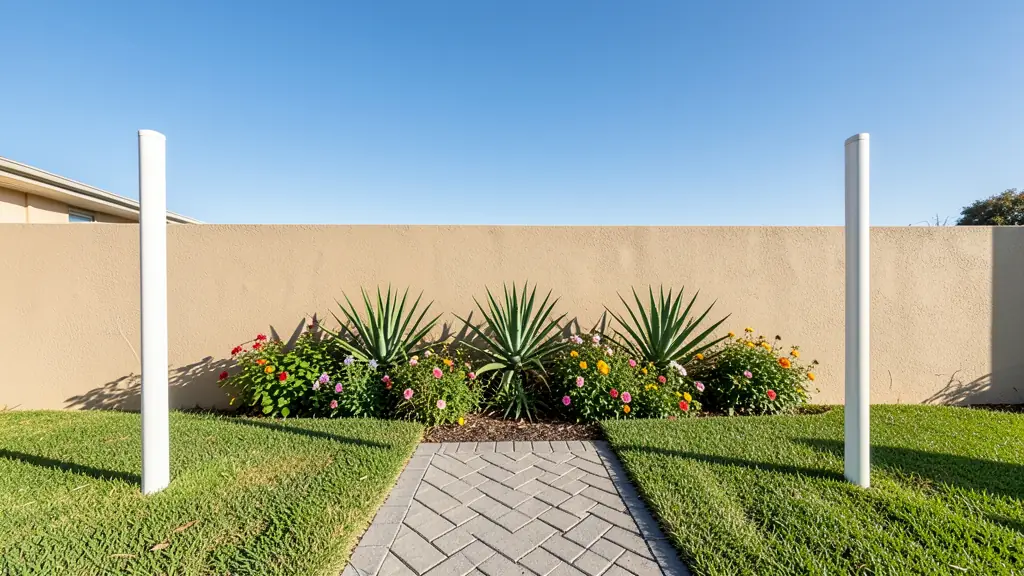
Security beams are the outdoor early warning of an alarm system. Each set is a transmitter and a receiver on posts or a wall, and when someone breaks the line between them, the alarm panel is told. Placed along a wall or across a garden, they give you seconds of warning before anyone reaches a door or window. Send one request with your property and layout, and independent installers quote you directly. It is free and there is no obligation. Beams normally connect to an alarm system.
Photoelectric and passive infrared beams
Two kinds are used outdoors. A photoelectric beam sends an invisible infrared line to a receiver, and an alarm is raised when the line is cut. A passive infrared (PIR) beam or outdoor sensor detects the body heat of someone passing through a fan-shaped zone and needs no receiver across the garden. Photoelectric beams give a straight detection line and suit walls and long straight runs. Outdoor PIR sensors suit areas where posts are hard to place, such as around corners or beside a building.
Dual-beam, quad-beam and range
A single beam can be tripped by a bird, a leaf or a spider web. Dual and quad beams use two or four parallel lines, and the alarm is only raised when more than one is broken in sequence, which looks like a person and not an animal. A set is sold by range, such as 30, 60 or 100 metres. The stated range is an open-field figure. In practice, as a guide, use about half of it for outdoor use, since rain and mist weaken the signal.
Mounting height is a trade-off. About one metre above the ground catches people crawling or walking, but small dogs and cats can trip it. Mounting at 80 to 100 cm on a well-fenced garden, or using a quad beam with the lower line off, helps households with pets.
Wired, wireless and solar
Wired beams need trenching or conduit for a cable, but they are reliable and have no batteries. Wireless beams save the digging, and either run on lithium batteries for a few years or on a small solar panel. Both must signal the alarm panel by radio, so check the range to the panel. Solar beams on a shaded side of the house may not charge enough in winter. For large plots and farms, discuss cameras as a second check.
Placement, false alarms and how many you need
Beams along a wall detect someone climbing over it, while beams across a garden detect someone already inside the boundary. A typical home uses two to six sets, covering the front and side boundaries, and the sides of the house. Avoid planting fast-growing shrubs, pointing sprinklers or the late afternoon sun into a receiver, since those cause most false alarms. Trim the garden every few months and test the beams monthly by walking through them. Connect them to armed response so a tripped beam brings a vehicle, not only a siren.
What to include in your request
- Boundary length and wall height
- Where you want detection: walls or garden
- Pets and their size
- Alarm panel you have, if any
- Wired, battery or solar preference
Security Beams for different sites
- Homeowners and families: two to six beam sets along the side walls and across the back garden
- Estates, complexes and body corporates: beams on the inside of the house plot, linked to the owner's alarm panel
- Offices, shops and retail centres: beams along the yard and parking boundary, armed outside trading hours
- Factories, warehouses and yards: long-range beams along inner fences and open ground, linked to a control room
- Building sites and contractors: wireless solar beams around the site container and material store
- Farms and smallholdings: beams around the farmhouse and sheds, with wireless links over longer ranges
- Events, venues, hotels and lodges: beams on the grounds and parking of lodges and guesthouses, armed at night
- Schools, clinics and churches: beams along the school boundary or behind a church, armed after hours
Frequently asked questions
How many security beams does a house need?
Will my dog or cat set off the beams?
Do wireless beams work during load shedding?
Why does my beam go off at sunrise?
Security Beams by province and city
- Johannesburg
- Pretoria
- Centurion
- Midrand
- Sandton
- Randburg
- Roodepoort
- Krugersdorp
- Randfontein
- Germiston
- Boksburg
- Benoni
- Kempton Park
- Alberton
- Vanderbijlpark
- Vereeniging
- Durban
- Pinetown
- Pietermaritzburg
- Richards Bay
- Newcastle
- Ladysmith
- Gqeberha (Port Elizabeth)
- East London
- Kariega (Uitenhage)
- Mthatha
- Cape Town
- Bellville
- Paarl
- Stellenbosch
- George
- Worcester
- eMalahleni (Witbank)
- Middelburg
- Secunda
- Mbombela (Nelspruit)
- Rustenburg
- Brits
- Klerksdorp
- Potchefstroom
- Mahikeng
- Polokwane
- Tzaneen
- Kimberley
- Upington
- Bloemfontein
- Welkom
- Sasolburg